North Texas Teens Want Adults to Start the Mental Health Conversation, Grapevine Roundtable Reveals
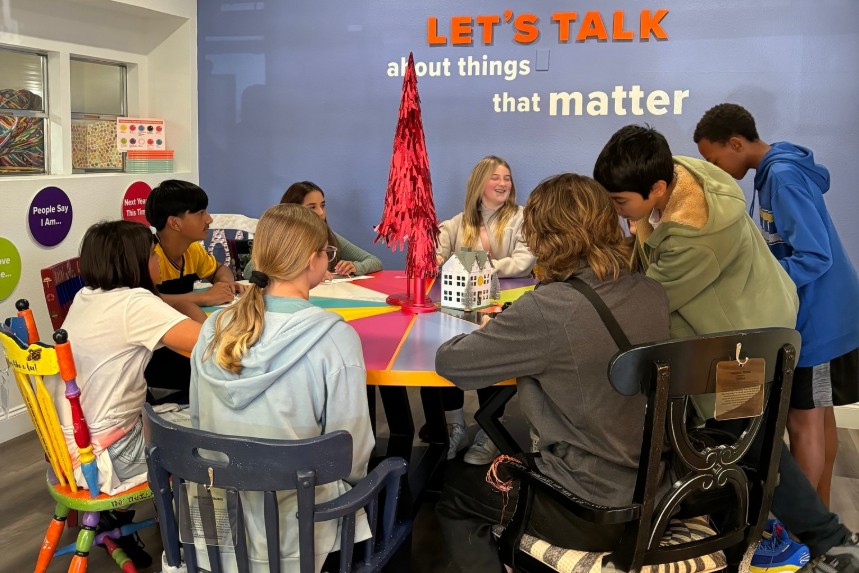
GRAPEVINE, Texas - Starting a conversation about mental health may seem like a simple task, but for many teenagers, speaking openly about their struggles can be difficult, particularly when they recognize that their parents are dealing with challenges of their own.
That was among the findings of a recent Bradley Roundtable Discussion hosted by House of Shine in Grapevine, where teenagers, parents, mental health professionals and other participants gathered to explore the relationship between teen mental health and community well-being in North Texas.
Rather than focusing exclusively on the challenges facing young people, the discussion examined the broader circumstances affecting families, including financial pressures, demanding work schedules, social isolation and unequal access to mental health resources.
Three important themes emerged from the discussion:
-
Teens want adults to initiate conversations. Young people often recognize when something is wrong but may hesitate to speak up because they fear adding to their parents' existing burdens.
-
Parents need support, too. Financial difficulties, work obligations and limited access to resources can make it challenging for parents to address their own mental health needs while supporting their children.
-
Community connections matter. Accessible gathering spaces, meaningful relationships and opportunities for social interaction can help young people and their families feel heard, valued and supported.
One of the most compelling aspects of the discussion was the willingness of teenagers to acknowledge the difficulties their parents face. Their observations suggest that addressing teen mental health requires more than encouraging young people to speak up. It also requires creating an environment in which adults have the support and emotional capacity to listen.
Participants explored practical ideas ranging from regular family activities and technology-free gathering spaces to accessible after-school programs where teenagers can build relationships and find support.
The discussion offers parents, educators, community organizations and local leaders an opportunity to consider their roles in supporting the mental well-being of young people.
House of Shine shared the following account of its Bradley Roundtable discussion for publication.
START THE CONVERSATION: A Community Conversation on Teen Mental Health and Well-Being in North Texas
Contributed by House of Shine, Grapevine, Texas
“I don’t really know how I’m feeling. I’m just here.”
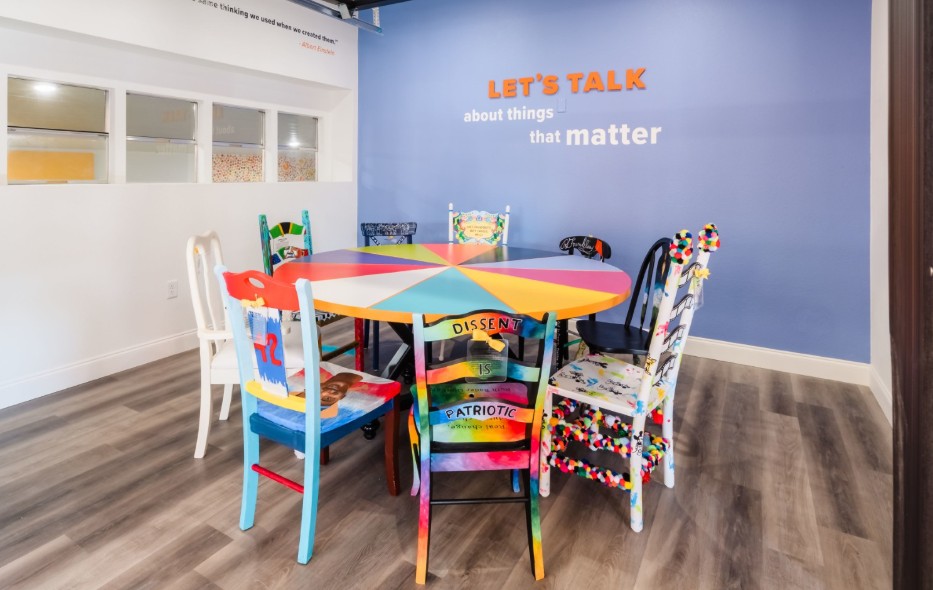
That was one person’s answer as we went around the circle on a Wednesday evening in late October, and it may have been the most honest sentence anyone offered all night. Around the table at House of Shine in Grapevine sat teens and adults who are passionate about teen mental health, including a young adult, parents and mental health professionals. We had gathered to explore one question: How does teen mental health impact community well-being in North Texas?
The conversation followed Edward de Bono’s Six Thinking Hats, a method that moves a group together from feelings to facts to new ideas, and then back to feelings.
WHAT WE FEEL
We began with one word from each person. People told us they felt curious, optimistic, intrigued, grateful and hopeful, and one was a little nervous and a little excited at once. Then came the answer that opened this article. We loved it, because that was the point of the exercise. Showing up is a feeling too, and sometimes it is all a person has to give. No one in the circle had to be anything other than present.
WHAT WE KNOW
With the white hat came the facts. The World Health Organization estimates that one in seven 10 to 19-year-olds lives with a mental health condition. A mental health professional told us that the number of young people seeking care in our area is “unreal,” and reminded us that the mind and the body cannot be treated separately, because sleep, food and rest change how a brain works. The teens recognized the pattern right away. They described friends who stay up until 1 a.m. finishing schoolwork and then struggle through the next day.
One parent offered an image of mental health that we will not forget. Sometimes, the parent said, it feels like a huge blue monster that you do not even know how to approach.
A gentler question followed. On a scale of zero to ten, where do most people want their lives to be? Everyone agreed that the answer is ten. A mental health professional then shared a study in which the happiest people averaged a six or a seven over the years, and reserved the tens for weddings, babies and graduations. A teen responded that a person can be at a five or a seven, or somewhere in between, and still be okay. We would love to see that message on a poster in every school hallway.
The most honest moment of the evening was also the simplest. Teens told us that they usually know when something is wrong. What stops them from saying so is fear of a bad reaction, of an awkward silence, or of becoming one more worry for someone who already has a full plate. When a facilitator asked whether they want their parents to ask how they are doing, one teen answered plainly.
“It would definitely be a lot easier if they started the conversation instead of [us] starting it.” - Teen participant
For parents, that may be the most important takeaway of the night: be the one who goes first.
WHEN PARENTS ARE CARRYING TOO MUCH
What happens, though, when going first is more than a parent has left to give? Our facilitator put that question to the circle. In so many families, the facilitator said, the adults are struggling themselves. They may not have a community of their own, or they may be working two or three jobs, with no room to slow down and think about their own well-being, much less their children’s.
A teen answered with more grace than many adults could manage. The teen said that it is probably a really tough spot for the adult, because when the problem is money or something else, it can be really hard for the parent. “I don’t necessarily know how to get through that,” the teen admitted, and neither did the rest of us. We heard the same pressure in everyday details. When asked what their families do together, teens mentioned a dad who works a lot, a brother who is usually working, and how hard it is to get everyone in one place.
Young people notice more than we think. Another adult asked whether some of the stress that teens carry comes from knowing what is happening at home, such as money being tight or parents going through a divorce. One participant, looking back on their teen years, said that it does. They could tell that something was going on with their parents, but no one would say what it was, so they kept their own struggle quiet as well. Years later, they learned that their parents had been holding back to protect them. “It was kind of rubbing off on each other,” the participant told us. The more stressed the parents became, the more stressed their child became, and no one in the house said a word about it.
A parent in the circle named what is missing for so many families. When parents are not connected to a community, that parent said, they are left doing their own thing and flailing, without other moms or dads to talk to and without anyone close enough to notice when something is off. In that parent’s words, everybody is like an island.
We left that part of the evening with a clear lesson. When a parent is struggling, their child feels it, and the causes are often bigger than any one household. Systemic challenges and unequal access to resources mean that not every parent has the support they need to care for their own mental health, let alone their child’s. That is not a failing on the part of parents. It is the reason the rest of us matter, and it is the reason every community needs places where both young people and parents can walk in and find someone in their corner.
WHAT WE IMAGINE
When the green hat went on, the room turned to ideas. One parent suggested a family “non-negotiable,” such as a game night that happens even when everyone is tired. For friends, the same parent suggested a code word that means “drop everything, I need you.” The invitation behind both ideas was simple: dare to connect.
A facilitator asked the teens where they already find community, and we wish you could have heard the warmth in their answers. One described a barn where, even on days when they are not ready to talk about what is wrong, they can sit with some “non-talking individuals” and feel fine. Another described a theater group that celebrates the closing of every show with a sleepover, and where, in the teen’s words, you can tell people about what is going on in your life.
One teen described moving from homeschool to a traditional brick-and-mortar school. The teen said that it was a lot more work, but that the community was better. Our facilitator asked whether struggling alongside other people is better than having less stress and no community. The teen replied, “It’s hard to admit, but I think it is.” The work was harder, and it was worth it because of the people.
The teens also imagined a casual after-school hub, not tied to any one sport or activity, where young people from every walk of life could eat, get help with homework and simply be around one another. They reminded us, too, that not every hard truth has to be spoken aloud. One teen explained that saying something difficult can take an hour and a half of rehearsing it in their head, while writing allows the words to come out. A note or a text can open the door just as well, as long as the adult on the other side is ready to listen.
A participant then shared a story that stayed with all of us. Some years ago, a mom from a school community in grief asked House of Shine for thirty small ceramic Shine Tokens, which was enough for one class. Our volunteers made one for every student instead, more than two thousand total, and each student received one at an assembly. A request for thirty became a token in every hand, which shows how far a small act of kindness can reach in moments of hurt.
TWO TRUTHS ABOUT PHONES
No topic divided the circle the way technology did. Some teens spoke candidly about the hours they lose to short videos, and one thought that phones should wait until college. Others disagreed. They pointed out that phones have made their generation more aware of mental health, and that for students in online school, a phone is how they connect with friends.
“When you’re in it, it can be a sense of community. When you’re outside of it, it creates a sense of isolation.” - Facilitator reflection
One of the adults asked whether it would help if a place simply announced that phones stay at the door for everyone. A teen answered without hesitation: “That’d be super helpful.”
FROM CONVERSATION TO ACTION
When we returned to the red hat, the words had changed. Participants now described themselves as empowered, reassured, reflective and eager. The adults said they were impressed by how thoughtful and well-spoken the young people were.
We did not solve teen mental health in one evening, and we never expected to. What we saw was quieter and more useful: young people are ready to talk, and they are watching to see who will ask. If you are a parent, we invite you to go first, and if you are running on empty, to let someone help you carry the load. If you are a teacher, you can help make feelings normal to talk about. If you are a neighbor, a business owner or a civic leader, you can help build the places where a teenager and a tired parent can both walk in and belong.
At House of Shine, we believe that healthy people come from healthy communities. That belief is why we gathered: to bring attention to the challenges affecting mental health in our community, and to explore how we can address them together. In a world full of screens, the Bradley Roundtable is proof that community still begins with a conversation, and that anyone can start one.
The Bradley Roundtable meets quarterly at House of Shine.
To attend a future session, apply for the Change Bowl, or receive publications, visit houseofshine.org or contact programs@houseofshine.org.