
Glistening Marble of the Grand Mosque and the Verdant Domes of Medina: Spiritual Landscapes
Where the Surface Reflects
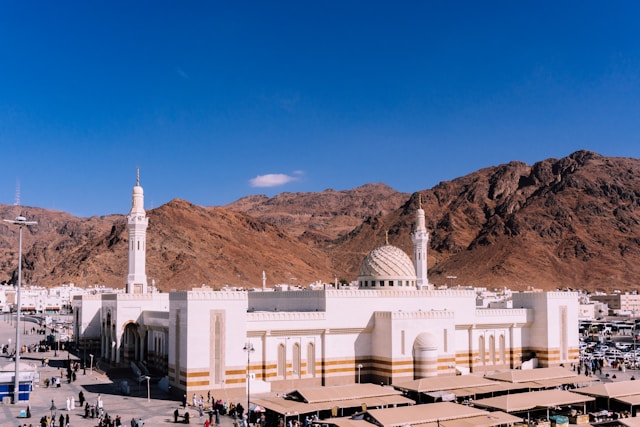
The courtyard does not reveal itself all at once. It opens gradually, the marble extending outward until it feels continuous, almost without edge. The surface reflects light in a way that shifts with each step, never holding a single image for long.
Even when still, it does not appear fixed. The brightness changes depending on where you stand. Lines in the stone guide nothing, but they remain present, repeating without insisting on direction.
What the Marble Holds
The ground carries movement differently here. Footsteps soften as they pass across the surface, dispersing rather than echoing. People move steadily, though not in a single rhythm.
On a nearby display, the route for the Haramain train appears briefly before changing to something else. It does not interrupt the space. It settles into the background, then disappears.
Reflections stretch and fade. Shapes appear beneath your feet, then shift as you continue walking. The scale becomes harder to measure, not because it is hidden, but because it extends so evenly.
There are moments where the space feels full, though never crowded. It adjusts without resistance.
Between Light and Structure
The mosque rises from the courtyard without separating from it. The transition is gradual. Columns appear, then open spaces, then shaded areas that hold the light differently.
Nothing stands alone. Each part seems to continue into the next without a clear boundary.
You move without deciding where to go. The space allows for it. It does not require direction.
Movement That Continues
Later, or somewhere beyond the courtyard, the sense of movement remains. It does not begin or end clearly. It carries forward.
Paths extend, then open again. The rhythm stays consistent, even as the surroundings shift.
Distance feels less defined. Places seem to follow one another without needing to be measured.
Where the Green Rises
Medina does not appear sharply. It gathers slowly, the domes emerging first, their green surfaces holding light differently from the marble left behind.
They do not dominate the skyline. They sit within it, distinct but not separate.
The color remains steady, even as the light changes around it. It does not reflect as much as it absorbs.
What the Domes Keep
From a distance, the forms appear uniform. Closer, small variations become noticeable. Slight differences in shape, in how the surfaces meet the light.
The space around them feels contained, though not closed. Movement continues, but in a quieter way.
You pause without choosing to. The stillness allows it.
Along the Surfaces
The ground here does not reflect in the same way. It holds the light instead of returning it.
Shadows gather more clearly. They remain longer before shifting.
People move through the space without forming patterns. Some stop, others continue. The rhythm does not change.
What Repeats Without Pattern
Over time, the differences between the marble and the domes begin to soften. Reflection and absorption, brightness and depth—they remain distinct, but less separate.
It is not a direct connection. More a gradual sense of continuity.
Details stay present, though less fixed.
The Space Between
The movement between the two places does not feel like a transition. It continues the same line. One space gives way to another without a clear break.
Differences exist, but they do not define the experience. They remain alongside each other.
Travel does not interrupt anything. It extends it.
Where It Doesn’t Resolve
Toward the end, if it is an end, the images begin to overlap. The reflective marble, the steady green domes, the movement that carries through both.
None replaces the other. They remain loosely connected.
There is no single moment that brings everything together. The elements stay separate, but not distant.
And then it continues. Not toward a conclusion. Just onward, in the same quiet way it began.


