
Sun-Drenched Alentejo Plains and the Rugged Cliffs of the Coast: Shifting Terrains
Where the Land Opens
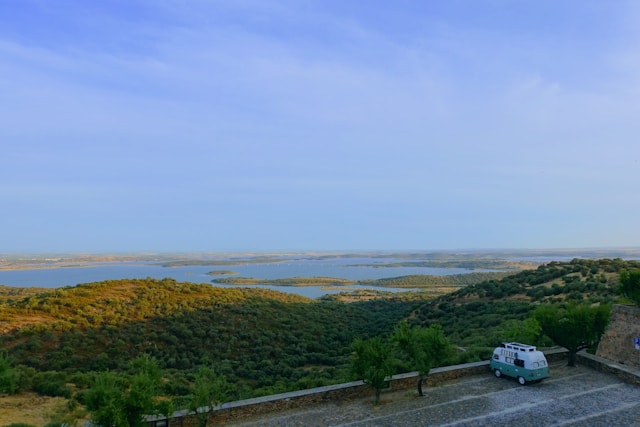
The plains do not begin with a clear boundary. They stretch outward gradually, the ground flattening until it feels continuous in every direction. The horizon lowers, making more space for the sky without changing the sense of distance.
The color holds steady at first. Dry tones, then deeper shades where the land shifts slightly. Nothing interrupts the surface for long. The eye moves across it without settling.
What the Fields Carry
On a small digital board near a quiet station, the words Lisbon to Porto train appear among other routes, then shift away before they can be followed.
The land here does not feel empty. It holds small variations that take time to notice. Slight rises, patches of darker soil, lines that suggest paths without fully becoming them.
Wind moves across the plains without resistance. It does not change direction sharply. It passes through, steady, as if it had always been there.
You walk without needing to adjust your pace. The ground allows for it.
Between One Stretch and the Next
There are moments where nothing seems to change, though time has passed. Then a small difference appears—a shift in color, a variation in texture—and it becomes enough to suggest movement.
It is not progress in a clear sense. More like continuation.
The plains do not guide direction. They leave it open.
Movement That Takes Another Form
Later, or somewhere along the way, the sense of motion shifts. Not abruptly. It feels like something already present, just continuing differently.
On a passing schedule display, the Alfa Pendular train is listed among departures, the line moving upward and disappearing as the board refreshes.
Distance becomes less exact. Places seem to follow one another without needing to be separated.
Where the Ground Breaks
The coastline does not arrive all at once. It interrupts the plains gradually, the flat land giving way to uneven ground. Then the cliffs appear, not sharply, but as a change that has already taken place.
The surface becomes rougher underfoot. Edges form where there were none before.
The ocean does not dominate the view. It extends outward, steady, without drawing attention to itself.
Along the Edge
Standing near the cliffs, the height becomes noticeable, though it does not press downward. It opens outward instead.
The water below moves in patterns that do not repeat exactly. Waves rise, then fall, then return in slightly altered forms.
You stop without deciding to. The space allows it.
What Repeats Without Pattern
Over time, the differences between the plains and the coast begin to soften. One stretches, the other breaks. Yet both carry the same quiet continuity.
It is not a direct connection. More a gradual awareness that settles without needing to be defined.
Details remain, though less fixed.
The Space Between
The movement between inland and coast does not feel like a transition. It feels like an extension. One form gives way to another without a clear dividing line.
Differences exist, but they do not organize the experience. They remain alongside each other.
Travel continues the same rhythm. It does not interrupt it.
Where It Doesn’t Settle
Toward the end, if it can be called that, the images begin to overlap. The open plains, the broken edges of the cliffs, the movement that carries through both.
None replaces the other. They remain loosely connected.
There is no single moment that brings everything together. The elements stay separate, but not distant.
And then it continues. Not toward a conclusion. Just onward, in the same quiet way it began.


